Our position
Why we list no peyote ceremonies
Peyote.com lists no peyote ceremonies, anywhere. Wild peyote grows slowly and is declining, it is the sacrament of the Native American Church, and the Church's national council has asked that peyote be left out of the decriminalisation movement. We send interest in mescaline to cultivated San Pedro instead.
Every statement below links to its source. Sources read 3 Oct 2026.
.jpg)
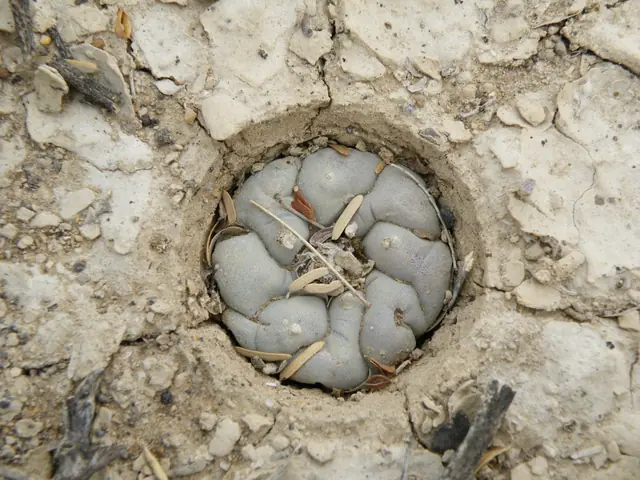
A slow plant in decline
- The IUCN Red List assesses peyote, Lophophora williamsii, as Vulnerable. (IUCN Red List, 2017; Imperial College London, via NEIP, 2019)
- NatureServe ranks it G3 (vulnerable) and, in its review of 7 October 2020, estimates a short-term decline of 10 to 30 percent and a long-term decline of 10 to 50 percent. It records the total population size as unknown, and cites habitat loss and overcollection; in south Texas the Tamaulipan thornscrub where peyote grows has been reduced to an estimated 2 percent of its original footprint. (NatureServe, 7 Oct 2020)
- Peyote can take up to 10 years to mature from seed. A large wild plant may be decades old: the botanist Martin Terry describes a plant destroyed by a harvester as one that "took 20-30 years to mature". (Imperial College London, via NEIP, 2019; Cactus Conservation Institute, 2014)
- The Cactus Conservation Institute reports that annual peyote harvests in Texas approach 2,000,000 buttons (crowns), and that harvesting every two years is a common practice among licensed distributors in South Texas. (Cactus Conservation Institute, current page; Cactus Conservation Institute, 2014)
A sacrament with its own law
- Peyote and mescaline are Schedule I controlled substances under federal law. (Legal Information Institute (Cornell), current)
- The one statutory exception is 42 U.S.C. 1996a, added by the American Indian Religious Freedom Act Amendments of 1994 (Public Law 103-344), not by the original 1978 Act: "the use, possession, or transportation of peyote by an Indian for bona fide traditional ceremonial purposes in connection with the practice of a traditional Indian religion is lawful, and shall not be prohibited by the United States or any State." (Legal Information Institute (Cornell), current)
- The DEA's own rule, 21 CFR 1307.31, says the Schedule I listing "does not apply to the nondrug use of peyote in bona fide religious ceremonies of the Native American Church", and requires anyone who supplies peyote to the Church to register annually. (eCFR, current)
- The Native American Church was incorporated in Oklahoma on 10 October 1918 and has an estimated 250,000 members; another estimate puts North American membership at 250,000 to 500,000. (Encyclopedia of Oklahoma History and Culture, current page; World Religions and Spirituality Project, 8 Oct 2016; Imperial College London, via NEIP, 2019)
- Legal supply comes from South Texas, where distributors register with the DEA and with the Texas Department of Public Safety. In August 2025 Texas Standard reported only four active licences to harvest and distribute peyote in Texas. (Texas Standard, 13 Nov 2018; Texas Standard, 21 Aug 2025)
- On 12 March 2020 the National Council of Native American Churches and the Indigenous Peyote Conservation Initiative asked that decriminalisation efforts "NOT include the word 'peyote' in any local decriminalization resolutions, initiatives, or efforts, put before governing bodies." (Psymposia, 16 Mar 2020)
Colorado drew the same line in statute
- Colorado's natural medicine law, as enacted by SB23-290, says: "'Mescaline' does not include peyote, meaning all parts of the plant classified botanically as Lophophora williamsii Lemaire, whether growing or not". (Colorado General Assembly, 23 May 2023)
- Before the 2022 vote, Colorado Public Radio reported that many Indigenous community members asked for the measure to explicitly exclude peyote from any future legalisation under it. (Colorado Public Radio, 6 Jul 2022)
Why it matters now
- A 2 December 2025 opinion of the Justice Department's Office of Legal Counsel, on Department of Education programmes, quotes a 1981 opinion that "An exemption for Indian religious use of peyote would not be grounded in the unique political status of Indians." Buffalo's Fire reported Native American leaders reacting to it as taking aim at congressional protections for peyote. An opinion does not amend the statute: 42 U.S.C. 1996a stands. (US Department of Justice, Office of Legal Counsel, 2 Dec 2025; Buffalo's Fire, 20 Feb 2026; Legal Information Institute (Cornell), current)
- Outside the exemption, federal penalties are those for any Schedule I substance not named in the large-quantity tiers: distribution carries up to 20 years and a fine of up to $1,000,000 for an individual on a first offence (21 U.S.C. 841(b)(1)(C)); simple possession carries up to 1 year and a minimum fine of $1,000 on a first offence (21 U.S.C. 844(a)). (Legal Information Institute (Cornell), current; Legal Information Institute (Cornell), current)
Where we send the interest instead
Mescaline is the primary alkaloid of San Pedro (huachuma) as well as peyote. We point readers to cultivated San Pedro, never wild plants, and the law on mescaline still applies where you are: check the legal status by country.
Cultivated plants only
The Andean curanderos who work with San Pedro have asked people to stop using wild plants, so we point only to cultivated San Pedro.
- On 1 December 2023 the Huachuma Collective, curanderos and curanderas of northern Peru, called on "practitioners of San Pedro ceremonies in Peru and around the world to stop using wild San Pedro and instead start cultivating the plant en masse from cuttings and seeds." The same statement opposes commercial San Pedro powder and chips. (Huachuma Collective, 1 Dec 2023; Huachuma Collective, English PDF, 1 Dec 2023; The Microdose (UC Berkeley Center for the Science of Psychedelics), 22 Jan 2024)
- San Pedro (Echinopsis pachanoi) is not on Peru's official list of threatened wild flora, Decreto Supremo 043-2006-AG. A 2013 report by the Ministry of the Environment, as Peru's CITES scientific authority, gives its conservation status as "En Peligro" (endangered), footnoted as proposed by the botanist Carlos Ostolaza for Peru only. The same report says San Pedro sold in Lima markets came mainly from the wild, and that export of wild Echinopsis from Peru is restricted. (Ministerio de Agricultura del Peru (FAOLEX copy), Jul 2006; Ministerio del Ambiente del Peru, 2013)
- Globally, the IUCN Red List assesses Echinopsis pachanoi as Least Concern (2017). Like all cacti not in Appendix I, it is in CITES Appendix II, so international trade needs export permits. (IUCN Red List, 2017; GBIF, 2017; CITES, current appendices)
What we do not claim
- Peyote.com is not affiliated with the Native American Church, the National Council of Native American Churches, the Indigenous Peyote Conservation Initiative or the Cactus Conservation Institute, and none of them endorses this site.
- No reliable count of wild peyote plants exists, so we publish none. The decline figures above are NatureServe's estimated ranges, not a measured census.
- Whether a particular person or ceremony falls within 42 U.S.C. 1996a or 21 CFR 1307.31 is a question for a lawyer, not for this page.
People have used peyote for a long time: peyote buttons from Shumla Cave in Texas were radiocarbon dated to 3780-3660 BC, about 5,700 years ago. (Journal of Ethnopharmacology, Oct 2005) The history, botany and ceremony are on our peyote overview.
Indigenous Peyote Conservation Initiative
Indigenous-led peyote conservation: in its own words, empowering Indigenous communities to reconnect with and regenerate peyote. In 2020 IPCI and the National Council of Native American Churches asked that decriminalisation efforts leave peyote out.
Support their work
Cactus Conservation Institute
Field research on wild peyote and star cactus populations in their natural range.
Support their work
We earn nothing from these links and never will.